



The future is electric. In case you haven’t noticed, we’re in the middle of a seismic shift in how we power our homes, vehicles, and gadgets.
Transport is seeing a shake-up the likes of which haven’t been seen in over a century. 24 countries have committed to banning the sale of fossil-fuel-powered vehicles by 2040, with many manufacturers phasing out gas and diesel car sales entirely within the next 8 years. These are being replaced with highly efficient battery-powered vehicles.
The cost of solar projects has dropped 85% in the past decade. 62% of wind, solar, and other renewables were cheaper than fossil fuels in 2020. Off-grid living is more than a possibility now; using renewable energy like solar is now the best way to save on your electricity bills. With new off-grid batteries, solar batteries, smart power storage, DIY battery packs, and DIY solar kits, it’s easy and financially sound to move to clean, renewable energy.
How has this change in the landscape been possible? Recent technological advancements in lithium-ion batteries are leading the charge. In 2014, a breakthrough increased lithium-ion battery storage by 50% or more, building on many advances discovered in the 2000s.
How are lithium-ion batteries different from lead-acid batteries?
So, how do lithium-ion batteries differ from the lead-acid batteries we’ve been using since their first invention in 1859?
The two types of batteries share the same working principles. Electrons store charge and release them through electrochemical reactions. They both use electrolytes, a membrane separator, and two electrodes (anode and cathode).
Where they differ is in their material composition. Where lead-acid batteries typically use Pb, PbO2, and H2SO4, lithium-ion batteries use carbon, lithium oxide, and lithium salt.
This has many practical benefits. Let’s look at just some of the ways that the latest lithium-ion batteries blow lead-acid batteries out of the water in the real world.
Lithium-ion batteries are up to six times lighter than lead-acid batteries
The biggest advantage lithium-ion (LiFePO4) batteries have over their lead-acid forefathers is weight. Lithium is the lightest metal on the planet. There are almost 30 times more atoms in a kilogram of lithium than there are in a kilogram of lead, which means we can store much more energy in a 1-kilogram lithium battery than we could ever hope to in a lead-acid battery.
Putting theoretical limits aside, the storage capacity of a lead-acid battery you can buy in the store comes in at around 30-40 Watt-hours per kilogram. In comparison, a lithium-ion battery can supply up to 250 Watt-hours per kilogram.
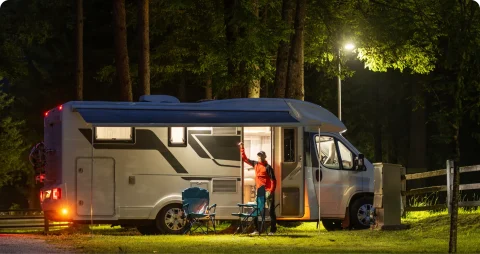
This lower weight has massive ramifications. RV batteries based on lithium-ion take up much less space and are so much lighter you get better fuel efficiency, for example. It’s no surprise that almost all portable gadgets use lithium-ion batteries, as they’re smaller, lighter, and can hold more charge.
Lithium-ion batteries last much longer than lead-acid batteries
Another hugely important factor for choosing lithium-ion batteries over lead-acid batteries is how much longer they last. If you use 80% or more of a lead-acid battery’s cycle each time, it will only work well for around 350 cycles. On the other hand, some manufacturers offer warranties for lithium-ion batteries of up to 10,000 cycles.
If you’re in the market for the best-priced batteries for your vehicle or home, lithium-ion batteries are the clear choice:
- Lithium-ion batteries can last 10 years or more
- This makes them around 3 times cheaper per KW/h than lead-acid batteries over their lifecycle
- They require no maintenance, so you get 10 years of uninterrupted, high-performance power
Lithium-ion batteries have up to six times the capacity of lead-acid batteries
Because lithium-ion batteries are so much lighter and compact, the capacity compared to lead-acid batteries is astonishing.
A lead-acid battery has an energy density of around 80 Wh/L. Lithium-ion batteries go up to 670 Wh/l. For our purposes, this means lithium-ion batteries will last much longer than lead-acid batteries before they need to be recharged.
Lithium-ion batteries can be discharged further than lead-acid batteries
We all know that rechargeable batteries degrade over time, but lead-acid batteries have particularly limiting charge windows. To increase the life of a lead-acid battery, manufacturers recommend only using the first 50% of your battery before recharging it. This essentially cuts the usable capacity of a lead-acid battery in half, because you’re constantly forced to recharge the battery or risk more degradation!
Lithium-ion battery degradation happens a lot later in the depth of discharge cycle. Most lithium-ion batteries can be 80% discharged without issue, and recent advancements mean discharging to 100% is fine for many lithium-ion batteries.
Lithium-ion batteries self-discharge slower than lead-acid batteries
No matter how well you treat your batteries, they will slowly lose their initial capacity. Lead-acid batteries suffer from a much faster discharge of up to 20% per month, whereas lithium-ion batteries discharge between 0.35 and 2.5% per month. This makes lithium-ion more convenient when used as a backup power source.
Lithium-ion batteries can be quickly charged
Lead-acid batteries don’t have a quick charge option. It takes between 6 and 15 hours to charge a lead-acid battery completely, and you must follow a set procedure of bulk charging, absorption charging, and float charging.
Lithium-ion batteries can be rapidly charged to 80% of their capacity in as little as 1 hour. The remaining 20% of power takes about 2-3 hours more, which makes lithium-ion at least 2-3 times faster to charge than lead-acid.
There is no reason to choose lead-acid over lithium-ion batteries
Because of the advantages of lithium-ion over lead-acid listed above, and more, there is now no reason to choose a lead-acid battery when a lithium-ion battery alternative is available.
Whether you need emergency power backup, forklift batteries, golf cart batteries, or batteries for an RV, lithium-ion is cheaper, lighter, more durable, and has less maintenance than lead-acid.
It’s time to ditch the old tech and save yourself a fortune with lithium-ion batteries.
References
-
- Car firms agree at Cop26 to end sale of fossil fuel vehicles by 2040 | Cop26 | The Guardian
- COP26 declaration on accelerating the transition to 100% zero emission cars and vans – GOV.UK (www.gov.uk)
- Renewables Were The World’s Cheapest Energy Source in 2020 | World Economic Forum (weforum.org)
- At long last, new lithium battery tech actually arrives on the market (and might already be in your smartphone) – ExtremeTech
-
- The Four Components of a Li-ion Battery (samsungsdi.com)
- Lithium, the periodic table’s lightest metal, is key for clean energy | Science News
- Curious Case of 50% Depth of Discharge for Lead Acid Battery | EcoSoch
Facebook
Twitter
LinkedIn
Pinterest
Frequently Asked Questions
How long do LiFePO4 batteries last?
A quality LiFePO4 battery can commonly deliver 4,000 or more charge cycles, often roughly 10 years or longer under the right conditions. Depth of discharge, temperature, charge settings, storage habits, and the BMS all affect the result.
How many years is 4,000 cycles?
One full cycle per day is about 11 years. Three cycles per week is more than 25 years on paper, though calendar aging becomes the limit first.
What happens at the end of a LiFePO4 battery's life?
It does not suddenly stop. It loses capacity gradually. A battery rated for 4,000 cycles may be specified to keep around 80% of its original capacity at that point.
Does temperature affect LiFePO4 battery life?
Yes. High heat speeds aging, and charging below freezing can damage cells unless the battery has low-temperature protection or self-heating.
How long does a lithium battery last in an RV?
Many years, when charging sources are configured correctly and the battery is protected from freezing charge conditions. Annual cycles are often fewer than in a daily solar system, but conditions vary more.
How should I store a lithium battery?
Store it at a partial state of charge in a clean, dry, moderate-temperature location. Disconnect parasitic loads and check it periodically per the manufacturer's guidance.