

It’s no secret that a home solar system can help put money back in your pocket, make your house less dependent on the electrical grid, and potentially even reduce your home’s carbon footprint.
But a residential solar system doesn’t offer all that it could in the absence of a solar battery bank, whether you are hooked up to the grid or not.
This post will explore some of the advantages of investing in a solar battery bank, even if your home doesn’t technically need one.
Not Every Home Needs a Solar Battery Bank, but Those That Do Benefit
For homes that are connected to the electrical grid, a solar battery bank is not an absolute necessity. Your solar panels will produce energy during peak hours that your home will use, and any surplus will get sent back to the grid.
Your utility company may even offer you a credit or a rebate for the surplus energy you produce, but even if not, during non-peak hours, your home can just rely on energy from the grid to get by.
This is not necessarily the ideal solution, and a solar battery storage system can help offer a significant number of advantages. Here are just a few of the best of them.
No Blackouts
Without a solar battery bank to store your surplus electrical energy, you will still be dependent on the grid during non-peak hours.
Normally, this should be no concern at all, but for two things. Blackouts are increasing in some areas of the country, and electrical prices have spiked as well.
For one, having a redundant solar battery backup will free you from blackouts that occur during non-peak hours when you’d need to rely on the grid, and for another, using the energy you produce is likely to be more economical, saving you money.
Energy During Off-Peak Hours
Even if you have no concerns about the cost of energy or of blackouts as a result of grid inefficiencies, if you have a solar battery bank, you can use energy during non-peak hours that your solar panels have produced.
Technically this only applies to users that are not attached to the grid, which makes it not so much of a benefit of solar battery backups as a necessity for homes that go completely off the grid.
Total Independence from the Grid
If you want to achieve total independence from the electrical grid, even if you don’t disconnect from it, the only way to do so is with a sustainable means of producing electricity, and a BESS, or a battery energy storage system.
Solar systems are not the only way to do this, and some homes use a combination of solar, wind, thermoelectric generation and wood gasification, and other means to achieve total grid independence, but in any case, you need an off-grid battery system to store the extra energy.
Use All the Power Your Home’s Solar Panels Generate
Lastly, a solar battery bank is the only way to use all of the extra energy your solar system produces, regardless of whether or not you are attached to the grid.
In the case that you were independent of the grid, you’d need the battery bank to store the excess energy produced during peak hours. Otherwise it would be totally wasted.
In the other case that you were still attached to the grid, if you produced more energy than your home could use during the day, that energy would get shuttled back to the grid. One would hope that your utility provider would give you a credit or a rebate, but there is no guarantee for this.
Therefore, to get the absolute most value out of your home’s solar energy system, the only way to do so is with a battery backup system that can handle what the panels produce.
Lithium Solar Battery Banks: Why Lithium Is Better
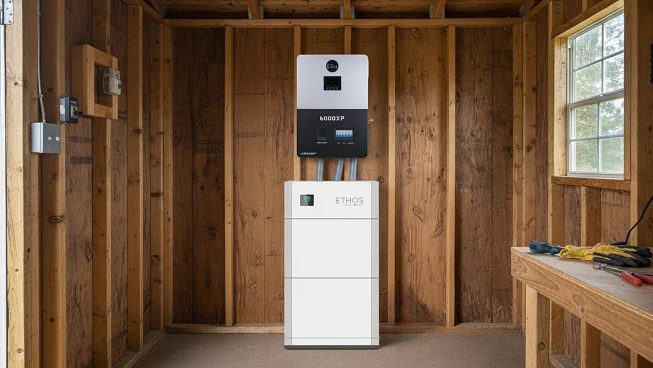
While there are alternatives to lithium solar battery banks, lithium batteries are the best in many ways. Here are just some of the biggest reasons to go with lithium (or to upgrade to lithium batteries, if you can reasonably do so):
- High energy density: Lithium batteries have a high energy density, which means that they can take a relatively high charge for their mass. This makes them highly economical in tight spaces, and also gives them the ability to deliver a lot of output.
- Compact size and weight: Not that you would be moving an array of rechargeable lithium batteries in a solar battery backup system around once it was installed, but they are easier to handle than most other alternatives, which are heavy, bulky, and generally unwieldy.
- Safety: There have been concerns about rechargeable lithium batteries in the past and in some cases, rightly so. However, modern lithium batteries are monitored by battery management systems (BMS) that control battery cell charge level, temperature, and more. In addition, modern lithium batteries, such as lithium iron phosphate batteries (AKA LiFePO4 or LFP batteries) feature much more stable battery chemistry that is less likely to experience thermal runaway and the other problems of lithium batteries.
- Longevity: Lithium batteries, when properly cared for, can last through a thousand charge cycles, and sometimes even more than that, giving them much better lifespan when compared to alternatives like lead-acid batteries.
- Minimal maintenance; Lithium batteries don’t really experience terminal discharge, don’t release gasses, don’t experience sulfation, and never need to be watered, unlike some other types of wet-cell batteries. They are much easier to care for.
- Our parts are non-proprietary: We are committed to the #RightToRepair movement, and therefore we don’t use proprietary parts in our batteries or systems. As a general rule, they can easily be repaired or upgraded.
To Learn More About Solar Battery Banks, Contact Us
Not sure where to start with solar battery backup or battery energy storage systems (BESS) in general? Don’t let the details overwhelm you. Get in touch with us and we will be more than happy to help you out.