



The world of batteries is complex enough even without introducing an additional layer of specificity, such as that associated with lithium solar batteries for homes, which are popular choices for home battery backup systems.
To make things easier, we compiled some of the more common terms associated with rechargeable lithium batteries, specifically solar batteries for homes and small businesses, and defined them here.
- Capacity
Capacity is the total overall charge that a battery can hold, determined by the maximum current that it can discharge over a unit of time. For home solar batteries, capacity is typically measured in amp-hours, or Ah, and is determined by multiplying the discharge of the battery in amps by the number of hours that said discharge can be maintained.
- Ah
Ah stands for amp-hour, as illustrated above, and connotes the number of amps that the battery can discharge over a period of hours.
- kWh
Like Ah, kWh, or kilowatt-hours, are a measurement of how much energy (in this case watts, or power) a battery can discharge over time. One kilowatt-hour is equivalent to a discharge of 1000 watts over the course of one hour.
- BMS
A BMS is a battery management system, which is a system that monitors, in this case, rechargeable lithium batteries. A battery management system can, among other things, monitor the temperature of a battery’s cells, provide over-charge and over-temperature protection, load and charge balancing, and even monitor the health of each cell.
- State of charge
A battery’s state of charge, or SOC, is a measurement of the remaining charge of a battery, given as a percentage. A fully charged battery has a SOC of 100%. Many battery management systems monitor SOC to prevent overcharging or deep-discharging so as not to damage a battery’s cells.
- Depth of discharge
Depth of discharge refers to how much of a battery’s total charge has been spent, given as a percentage. For example, if the depth of discharge is 50%, then half of the battery’s total charge has been discharged.
- Energy density
Energy density refers to how much energy a battery can hold in relation to its mass. Lithium batteries are renowned for their high energy density, which means that, despite their low mass, they can hold a relatively high charge.
- Cathode
The cathode is the electrode at which reduction takes place during an electrochemical reaction. The positive terminal is typically referred to as the cathode, but in rechargeable batteries, the cathode is only the positive electrode during discharge. When the battery is recharging, the cathode becomes the negative electrode.
- Anode
The anode is the electrode at which oxidation occurs during an electrochemical reaction. It is the negative electrode during discharge but flips to the positive electrode during recharge.
- Deep cycle
A deep cycle battery is a type of battery that is designed to be repeatedly drained and fully charged. Many lithium marine batteries are deep cycle batteries.
- LiFePO4
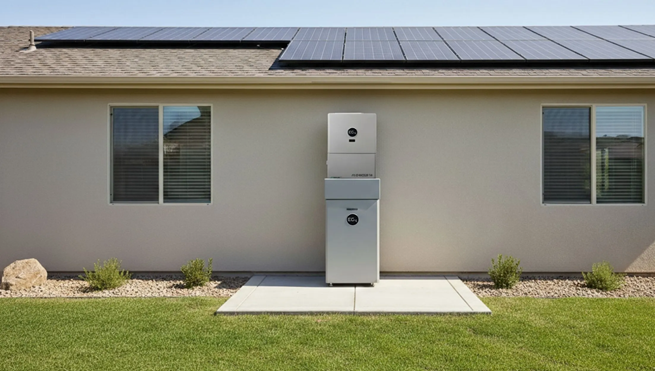
LiFePO4 batteries constitute a class of modern rechargeable lithium batteries that use lithium iron phosphate as their cathode material. They are notable because lithium iron phosphate is much more stable than many other types of lithium battery chemistries, making them safer because they are less prone to thermal runaway or general overheating during charging or use. Many solar batteries for homes are LiFePO4 batteries.
- Charge retention
The charge retention of a battery is how much of the battery charge remains after the battery has been in storage for a period of time, expressed as a percentage.
- Discharge rate
The discharge rate is the current that flows from a battery during use, in small batteries referred to as milliamps, and in larger batteries, in amps.
- Self discharge rate
The self discharge rate is the rate at which a battery that is not connected to a circuit will lose charge over time. For most quality rechargeable lithium batteries, the discharge rate is between 1% to 3% per month, but this is dependent on the state of charge, the battery chemistry, and conditions.
- Cycle life
The cycle life is the expected number of cycles the battery can charge and discharge before the battery loses the ability to hold a charge and becomes nonfunctional.
- Over discharge
Over discharge refers to the attempt to continue discharging a battery after all of its charge has been spent, which can damage the battery. Many modern lithium batteries are equipped with management systems that provide some level of over discharge protection.
Explore Solar Batteries for Your Home Here
Hopefully you found this guide helpful and now you feel less overwhelmed when presented with the specifications of some rechargeable lithium battery or another.
All the same, we realize it can be difficult to pick out a home battery backup (or a system) so we are here to help. Get in touch with us and we will be more than happy to help you parse the details and pick out a system that works for your home and its solar energy system.
Frequently Asked Questions
How long do LiFePO4 batteries last?
A quality LiFePO4 battery can commonly deliver 4,000 or more charge cycles, often roughly 10 years or longer under the right conditions. Depth of discharge, temperature, charge settings, storage habits, and the BMS all affect the result.
How many years is 4,000 cycles?
One full cycle per day is about 11 years. Three cycles per week is more than 25 years on paper, though calendar aging becomes the limit first.
What happens at the end of a LiFePO4 battery's life?
It does not suddenly stop. It loses capacity gradually. A battery rated for 4,000 cycles may be specified to keep around 80% of its original capacity at that point.
Does temperature affect LiFePO4 battery life?
Yes. High heat speeds aging, and charging below freezing can damage cells unless the battery has low-temperature protection or self-heating.
How long does a lithium battery last in an RV?
Many years, when charging sources are configured correctly and the battery is protected from freezing charge conditions. Annual cycles are often fewer than in a daily solar system, but conditions vary more.
How should I store a lithium battery?
Store it at a partial state of charge in a clean, dry, moderate-temperature location. Disconnect parasitic loads and check it periodically per the manufacturer's guidance.