






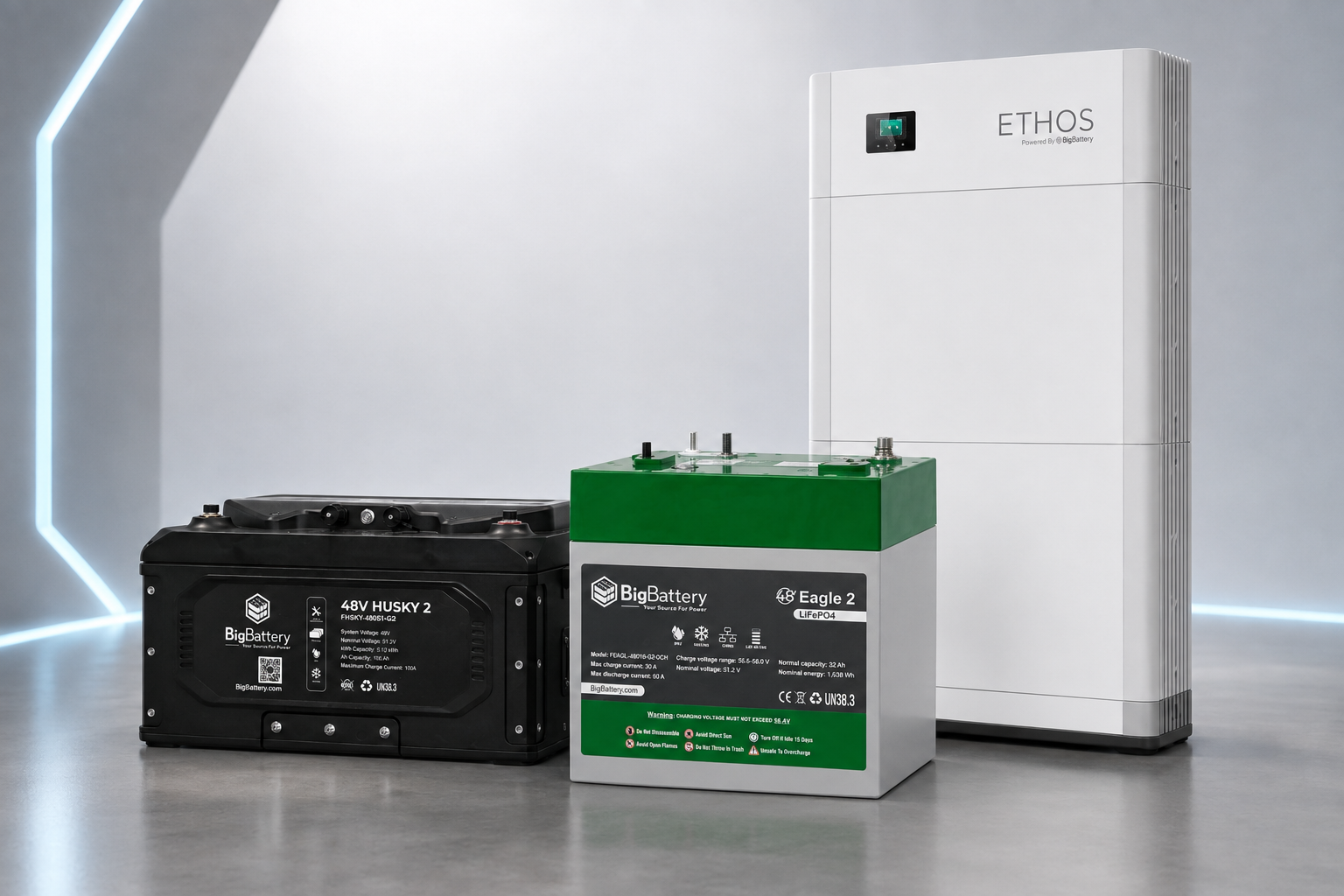
A 48V lithium battery often marks the shift from a collection of parts to a serious energy system. It supports larger inverter loads, moves more solar energy, and reduces the high-current problems common at 12V and 24V.
Voltage alone does not show whether a battery will meet your needs. The choice depends on capacity, continuous discharge capability, charging requirements, BMS communication, and how the components work together.
To size a 48V lithium battery, convert your daily load to kWh, multiply by the hours or days of backup you want, and divide by usable depth of discharge. An 8 kWh overnight load at 80% depth of discharge needs about 10 kWh of nominal storage, which is two 5.12 kWh batteries. Then confirm the battery’s continuous discharge current covers your inverter. Shop 48V Lithium Batteries for more!
Why a 48V Lithium Battery Changes System Design
Power equals voltage times current. A 5,000-watt inverter on a 12V battery can draw more than 400 amps with losses. At 48V, the same load is closer to 100 to 120 amps.
Approximate battery current for a 5,000W load
Assumes 90% inverter efficiency and LiFePO4 nominal voltage.
| System voltage | Nominal voltage | Approximate current |
|---|---|---|
| 12V | 12.8V | 434A |
| 24V | 25.6V | 217A |
| 48V | 51.2V | 109A |
Lower current means smaller cables, less voltage drop, less connection heat, and fewer inverter-size limits. Undersized cables and loose lugs can cause nuisance shutdowns or safety problems. That also makes 48V a good match for larger solar arrays.
Most 48V LiFePO4 systems are 51.2V nominal: 16 cells in series at 3.2V each. Always confirm the battery’s actual charge and discharge voltage range against the equipment manual.
How to Size a 48V Lithium Battery: Start With Energy Needs
kWh gives a more complete comparison than amp-hours. A LiFePO4 battery labeled 48V runs at 51.2V nominal, so a 100Ah unit stores 5.12 kWh. Multiplying by the 48V label gives 4.8 kWh and understates what the battery holds.
Use this formula: battery energy (kWh) = nominal voltage × amp-hours ÷ 1,000.
A cabin using 8 kWh overnight is not covered by one 5.12 kWh battery. Inverter losses, cold, reserve, aging, and surprise loads all matter. A practical target may be 10 to 15 kWh nominal, depending on how much autonomy you need to cover an outage and whether solar can reliably recharge the bank the next day.
How Many 48V Batteries for an Overnight Load
Nominal capacity at 80% usable depth of discharge.
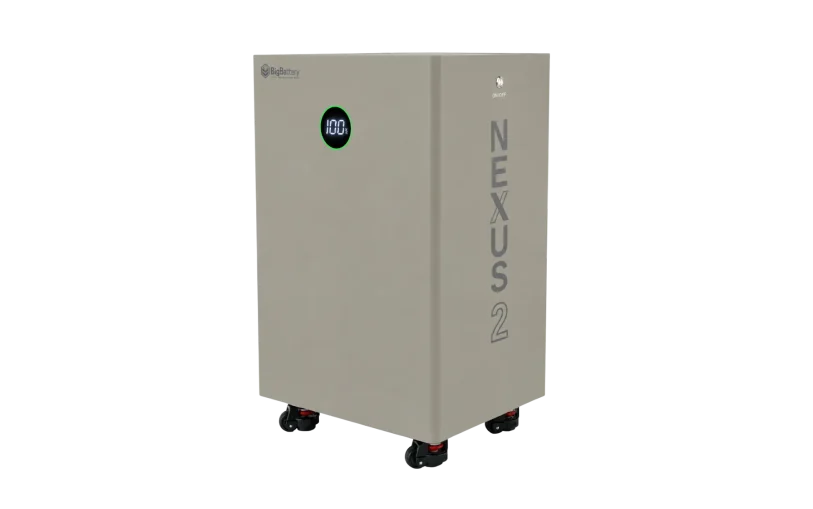
| Overnight load | Nominal capacity needed | Husky 2 INV (5.12 kWh) | NEXUS 2 (16.08 kWh) |
|---|---|---|---|
| 4 kWh | 5 kWh | 1 battery | 1 battery |
| 8 kWh | 10 kWh | 2 batteries | 1 battery |
| 12 kWh | 15 kWh | 3 batteries | 1 battery |
RVs. Sizing starts with actual daily use. A compressor fridge, lights, pump, laptops, TV, and an occasional microwave can total several kWh per day. Running air conditioning from battery power is a much larger demand, and it needs careful inverter, battery, alternator, solar, and charging design. See BigBattery’s RV and van lithium batteries.
Golf carts and utility vehicles. Match capacity to route length, terrain, payload, tire condition, and charging opportunity. Replacing lead-acid batteries with lithium can reduce weight and deliver more usable capacity, but the system must match the motor controller and charger voltage. See BigBattery’s golf cart lithium batteries.

Size for Both Runtime and Peak Power
Capacity determines runtime. Discharge current determines whether your loads can run at all. A 6,000-watt 48V inverter may draw about 125 to 150 amps at full output. If the BMS allows only 100 amps continuous, the inverter can overload the battery even if the battery has plenty of stored energy.
Two 48V Batteries Compared
| Spec | Husky 2 INV | NEXUS 2 |
|---|---|---|
| Nominal voltage | 51.2V | 51.2V |
| Capacity | 100Ah, 5.12 kWh | 314Ah, 16.08 kWh |
| Max continuous discharge | 100A | 140A |
| Communication | CAN bus, RS485 | CAN bus, RS485, RJ45 |
| Parallel expansion | Up to 16 | Up to 15 |
| Cold weather | Self-heating | Self-heating |
| Warranty | 12 years | 12 years |
A 6,000-watt inverter at 51.2V draws about 117A before losses. A single 100A battery cannot carry that load for long, so pair it with two batteries in parallel or a battery with a higher continuous rating.
Before pairing, also check peak discharge current and duration for motor surges, maximum charge current for large solar arrays and generators, and BMS communication compatibility. The BMS monitors cell voltage, temperature, current, and faults. A BMS shutdown is protection, not normal operation. Repeated trips mean the system is undersized or misconfigured.
Choose LiFePO4 for the Job It Will Actually Do
A LiFePO4 battery is widely chosen for stationary storage, RVs, marine, golf carts, and industrial use because of its thermal stability, deep-cycle performance, long life, and low maintenance. A properly sized battery can often deliver 4,000 or more cycles under favorable conditions. Results vary with depth of discharge, charge rate, temperature, storage habits, and workload.
Lead-acid is cheaper upfront, but it has lower usable capacity for a reasonable life, charges more slowly near full, loses performance as voltage sags, and is heavier. A 48V LiFePO4 battery costs more upfront but can offer more usable energy, steadier voltage, faster charging, and a lower cost per cycle. For critical uses, such as a ranch gate that cannot lose power or home backup during an outage, choose for dependable performance rather than the lowest price.
Confirm Compatibility Before Ordering
Verify the inverter’s DC voltage window, low-voltage shutdown setting, charge profile options, and maximum battery current. For a 51.2V LiFePO4 battery, configure a programmable inverter or charger using the manufacturer’s recommended settings.
Some systems use CAN bus or RS485 communication between the battery and inverter. When both products support it, the battery can send charge and discharge limits to the inverter, letting the system respond as temperature and state of charge change.
The Husky 2 INV lists closed-loop communication with the EG4 6000XP, the EG4 12000XP, and the Victron MultiPlus-II 48/5000. Specs and manuals for every model are in Product documents.
Proprietary ecosystems can limit inverter options and make replacement harder. Choose equipment with documented compatibility and clear technical support. For parallel expansion, confirm the maximum number of paralleled batteries, cable layout, fuse protection, and matching by model, age, and firmware. Balanced cable lengths help each unit share current fairly.
Installation Details That Protect Your Investment
Use properly sized copper cable, correctly rated fuses or breakers, and secure crimped lugs. Place overcurrent protection close to the positive terminal, follow torque specs, and cover terminals. Mount in a clean, dry, protected location with service clearance. LiFePO4 does not need the same charging-gas ventilation as flooded lead-acid, but the system still needs airflow and protection from water, vibration, and damage.
Charging below freezing can damage cells unless the battery includes low-temperature charge protection or integrated heating. Discharging in cold is often possible at reduced performance, but the charging rules are stricter. Garages, boats, and seasonal cabins need a winter plan. Both the NEXUS 2 and the Husky 2 INV list self-heating for cold-weather charging.
Build for the Next Outage, Trip, or Workday
The best system is not necessarily the largest. It should carry your expected loads, accept your available charging power, handle surge demand, and keep reserve for non-ideal conditions. Build a realistic load list, calculate energy in kWh, confirm current limits, and verify compatibility.
A system-sizing calculator and a conversation with a real technical expert can prevent an expensive mismatch. The goal is power that stays available when the grid, shoreline, generator, or work schedule cannot be trusted.
Get Help Choosing a 48V Lithium Battery
BigBattery’s U.S.-based experts can turn your load list into a 48V system plan. Shop 48V lithium batteries, run your loads through the Solar Battery Sizing Calculator, or call (818) 280-3091.
Frequently Asked Questions
How many kWh is a 48V 100Ah lithium battery?
A LiFePO4 battery labeled 48V runs at 51.2V nominal, so a 100Ah unit stores 5.12 kWh. The formula is nominal voltage multiplied by amp-hours, divided by 1,000.
Is a 48V lithium battery really 51.2V?
Most 48V LiFePO4 batteries use 16 cells in series at 3.2V nominal each, which makes 51.2V. They are called 48V because they work with the 48V-class inverters, chargers, and solar equipment sold in the US.
How many 48V batteries do I need?
Divide your daily or overnight load in kWh by usable depth of discharge, then divide by the battery's kWh. An 8 kWh overnight load at 80% depth of discharge needs about 10 kWh, or two 5.12 kWh batteries.
What inverter size can a 48V battery run?
It depends on the battery's continuous discharge current. A 6,000-watt inverter draws about 117A at 51.2V before losses, and more once losses are counted, so a battery limited to 100A can overload even with plenty of stored energy. Check continuous and peak discharge before pairing them.
Can I charge a 48V LiFePO4 battery in freezing weather?
Not unless the battery has low-temperature charge protection or self-heating. Discharging in cold weather is less restricted, but capacity still declines.
Does my 48V battery need to communicate with the inverter?
Not always, but CAN bus or RS485 lets the battery send charge and discharge limits to a compatible inverter. That helps the system respond as temperature and state of charge change.