





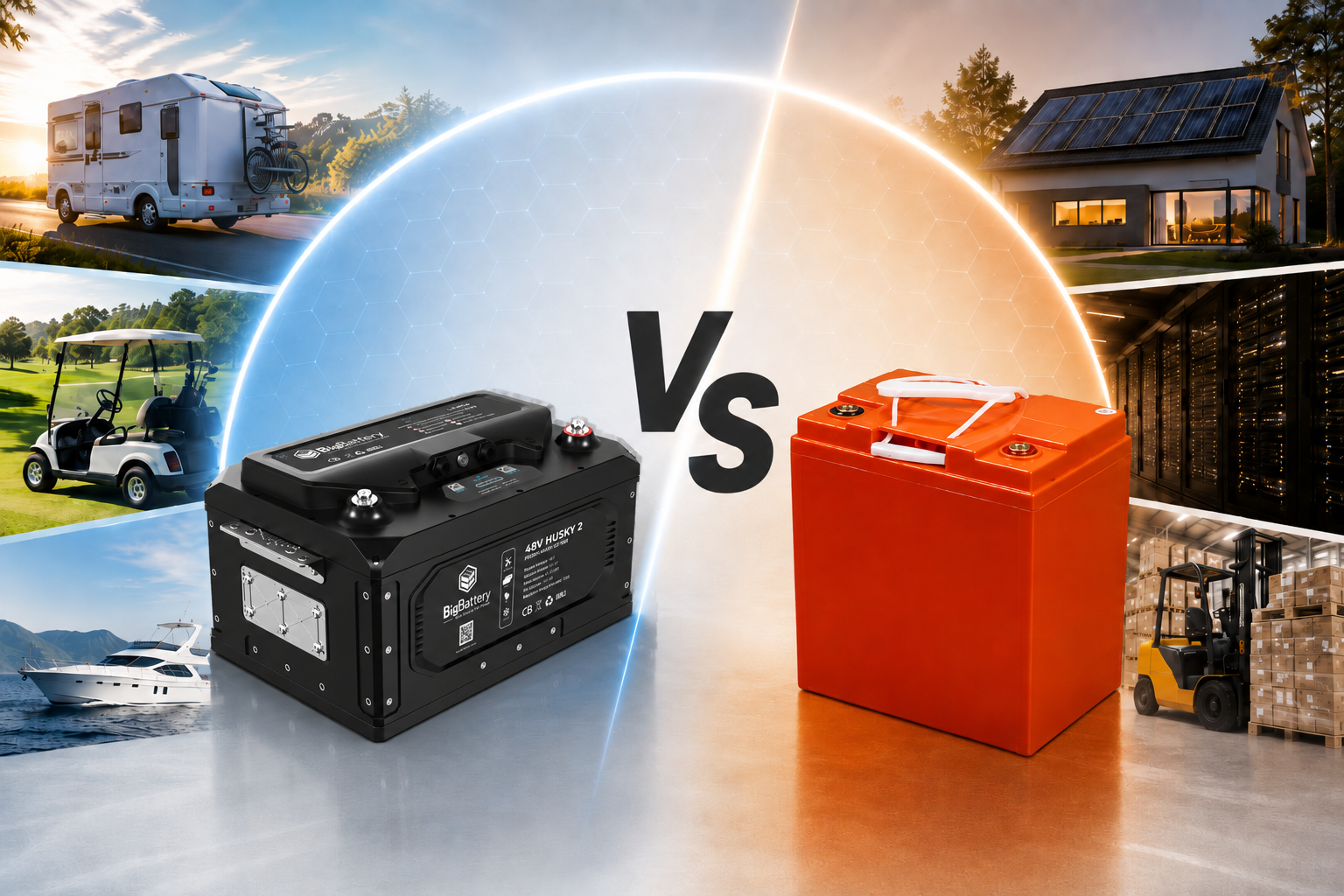
A battery bank that looks large on paper can still leave you short on power when half its rated capacity is effectively off limits. That is the daily frustration many lead-acid owners know well. A LiFePO4 battery changes the equation by delivering more usable energy, holding voltage better under load, and avoiding the routine maintenance that comes with flooded batteries.
For an RV refrigerator, a home backup system, a golf cart, or an industrial machine, the point is not simply to buy lithium. The point is to select a battery system with the right voltage, capacity, charging equipment, and battery management system for the work it needs to do.
What Makes a LiFePO4 Battery Different?
LiFePO4 stands for lithium iron phosphate, a lithium battery chemistry built for deep-cycle energy storage. Unlike starter batteries, which provide a brief burst of high current to crank an engine, deep-cycle batteries are designed to supply energy steadily and repeatedly.
Compared with conventional lead-acid batteries, LiFePO4 batteries are lighter, charge faster, and can typically be discharged much deeper without damaging the cells. A properly engineered lithium iron phosphate battery can also deliver 4,000 or more charge cycles, depending on depth of discharge, temperature, charging practices, and system design.
That matters because battery value is not just a price tag. It is the amount of usable energy and service life you receive over years of use. A low-cost lead-acid bank may need replacement several times while a quality LiFePO4 system remains in service.
Usable Capacity Is the Number That Matters
A 100Ah lead-acid battery is not equivalent to a 100Ah lithium battery in real use. To protect lead-acid battery life, many owners plan around using only about 50% of rated capacity. Pulling it down further on a regular basis can shorten its life significantly.
A LiFePO4 battery is commonly designed to provide far more of its rated capacity. That means a 100Ah lithium battery can often replace a much larger lead-acid bank for the same practical runtime. It also maintains a more stable voltage as it discharges, which helps sensitive electronics, inverters, trolling motors, and appliances operate more consistently.
Why LiFePO4 Batteries Fit Demanding Applications
Lithium iron phosphate is especially useful where weight, runtime, and uptime affect the experience or the bottom line. Removing several hundred pounds from an RV or boat can improve payload flexibility. Faster charging can shorten generator run time at a cabin. Higher usable capacity can keep a refrigerator, communication equipment, or medical device powered through a longer outage.
For fleet equipment, the benefits are just as tangible. Floor machines, scissor lifts, utility vehicles, and other electrically powered assets lose productive time when batteries charge slowly or need frequent replacement. A lithium conversion can reduce maintenance and support more consistent daily operation, provided the charger, voltage, connectors, and duty cycle are compatible.
LiFePO4 is also a practical chemistry for residential solar and backup power. Solar production is limited to daylight hours, while a battery bank must cover evening loads, cloudy periods, and outages. Higher round-trip efficiency means more of the solar energy you produce remains available for use instead of being lost during charging and discharging.
The Battery Management System Is Not Optional
Every quality LiFePO4 battery needs a battery management system, or BMS. This electronic control system monitors cell voltage, current, and temperature. It can disconnect the battery when conditions move outside safe operating limits, such as overcharging, over-discharging, excessive current draw, or charging in freezing temperatures when the battery does not support it.
The BMS is not an accessory. It is a core part of lithium battery safety, performance, and longevity. For larger systems, communication between the battery and inverter can be equally valuable. Open communication protocols and broad inverter compatibility give system owners more choices than proprietary ecosystems that limit future upgrades or force them into one equipment brand.
A battery with a capable BMS may still shut down if it is installed into the wrong system. An undersized cable, incorrect fuse, incompatible charger, or inverter with a high surge demand can create problems that look like a battery failure. Good system design matters as much as cell chemistry.
Choose Voltage Before Choosing Capacity
Voltage determines how a battery integrates with your equipment. Capacity determines how long it can run. Both must match the application.
A 12V battery is common in smaller RV, marine, trolling motor, and portable power setups. A 24V or 36V system may be appropriate for specific trolling motors, mobility equipment, or industrial applications. Golf carts and utility vehicles often use 36V, 48V, or 72V configurations. Home solar, backup, and off-grid systems frequently use 48V because higher voltage reduces current for the same power output, allowing for more efficient system design.
Do not assume you can swap battery voltage without changing other equipment. A 48V inverter requires a 48V battery system. Chargers must match the battery bank’s nominal voltage and lithium charging profile. If batteries are connected in series, they should be compatible for series use and installed according to the manufacturer’s instructions.
Size for Energy, Not Just Amp Hours
Amp hours are useful, but watt hours and kilowatt hours provide a clearer picture across different voltages. The basic calculation is:
Watt hours = battery voltage × amp hours
A 12V 100Ah battery stores roughly 1,200 watt hours, or 1.2kWh. A 48V 100Ah battery stores roughly 4,800 watt hours, or 4.8kWh. Actual usable energy depends on battery settings, discharge limits, operating temperature, inverter losses, and the battery’s BMS.
To estimate the battery bank you need, start with the loads you actually plan to run. Add the wattage of each device, estimate how many hours it will operate, and calculate daily watt hours. Then account for inverter efficiency, solar conditions if applicable, and the number of days of reserve power you want.
For example, a 1,000-watt appliance running for one hour uses about 1kWh before inverter losses. In a 12V system, supplying that load requires substantial current. In a 48V system, the current is much lower. That is one reason larger stationary systems are usually better served by 48V architecture.
Trade-Offs of LiFePO4 Versus Lead Acid
LiFePO4 is a strong long-term choice, but it is not a universal drop-in answer. Upfront cost is typically higher than lead acid. Older chargers may not have an appropriate lithium profile. Cold-weather charging requires attention because many lithium batteries should not be charged below freezing unless they include low-temperature protection or internal heating.
High-power applications also need careful planning. An inverter may draw far more current than expected during startup surges. The battery’s continuous and peak discharge ratings, cable gauge, fuse sizing, disconnects, and busbars all need to support the system safely. More battery capacity does not automatically solve a current-delivery limitation.
For simple replacement projects, an application-specific lithium battery kit can remove much of the uncertainty. For solar, backup, and off-grid projects, a sizing calculator and direct conversation with technical support can prevent expensive mismatches. BigBattery’s Texas-based experts can help customers evaluate voltage, kWh capacity, inverter compatibility, and expansion plans before equipment is installed.
Installation Habits That Protect Your Investment
A lithium battery system rewards careful installation. Keep cable runs short and appropriately sized, protect every major positive conductor with correctly rated overcurrent protection, and mount batteries where they are secure, dry, and accessible. Follow torque specifications at terminals because loose connections create heat and voltage drop.
Use a charger designed for LiFePO4 chemistry, or confirm that adjustable charging settings match the battery manufacturer’s requirements. Avoid equalization settings intended for flooded lead acid batteries. If your system includes solar charging, verify the charge controller profile and temperature settings as well.
For multi-battery banks, use balanced wiring so each battery shares charge and discharge current as evenly as possible. This is particularly important for parallel configurations. Monitor battery state of charge through a reliable display, app, or system communication interface rather than relying only on voltage readings.
A battery should make your power system less complicated to live with, not more complicated to manage. Select the voltage that fits the equipment, calculate energy in kWh, verify charging and inverter compatibility, and leave room for the loads you may add later. That is how a LiFePO4 battery becomes dependable power you can actually use when it matters.