



Still using an AGM battery in your camper or for some other application? It might be time to upgrade to a LiFePO4 battery from us. The benefits are many.
We’ll cover them here, along with some basic information on the distinction between AGM batteries and other lead-acid batteries.
Sure, AGM Batteries Are Better Than Some Lead-Acid Batteries, but Lithium Is Still Better
It is true that not all lithium batteries are the same, and neither are all lead-acid batteries. Case in point: flooded cell vs. AGM lead-acid batteries.
AGM batteries differ considerably from flooded call lead acid batteries. AGM batteries, which stands for “absorbent glass mat”, are an advanced type of lead acid battery.
They are superior to flooded cell batteries on several fronts because they contain a fiberglass mat that seals the electrolyte in place.
Because they are sealed, there is no need to ever water AGM batteries to refill the cells. They also charge quickly and do not off-gas, like flooded cell batteries.
In addition, AGM batteries are also spill-proof and highly resistant to vibration.
It’s fair to call them a significant upgrade over older, flooded cell lead acid batteries, but better though they are, a LiFePO4, or LFP battery is still a significant upgrade.
1. LiFePO4 batteries are lighter
One of the main benefits of LiFePO4 batteries is that they have a higher energy density, which means that a lower mass battery can hold the same or a higher charge as a heavier battery. As a result, comparable LiFePO4 batteries are lighter and more compact than AGM batteries.
2. They last longer
Another one of the big advantages of LiFePO4 batteries is that they can last through several thousand charge cycles. In some cases they can last between 3000 and 10000 if not more, which generally equates to 5 to 10 years of lifespan. This helps to offset the higher upfront costs associated with rechargeable lithium batteries.
3. The depth of discharge is better with lithium
Lithium batteries offer a better depth of discharge than comparable AGM batteries, which in basic terms means, with the same charge, a lithium battery will offer more power output. Also, the output level of lithium batteries is more stable as the voltage level drops, whereas with lead acid batteries, the power tends to drop as the voltage drops.
4. They charge quickly
Forgot to charge that AGM battery for your trolling motor or RV the day before a trip? Depending on the charge level of the battery and your type of charger, that can be a problem. With a lithium battery like a LiFePO4 battery, it shouldn’t be. Rechargeable lithium batteries can typically take a full charge between 1 to 5 hours (depending on how discharged they are) whereas an AGM battery usually takes overnight.
5. They’re low maintenance
As lead-acid batteries go, AGM batteries are relatively low maintenance, because the electrolyte is sealed in the absorbent glass mat. As a result, AGM batteries don’t need to be watered like flooded cell batteries. Nonetheless, they can still experience issues associated with terminal corrosion if overcharged or under other circumstances. By and large, despite their comparative advantages over other lead acid batteries, lithium batteries, specifically LiFePO4 batteries, require even less maintenance.
6. Low self-discharge
One of the strongest advantages of LiFePO4 batteries is that they experience very low self-discharge rates. A fully charged AGM battery will self-discharge at a rate of approximately 1-3% per month, but LiFePO4 batteries self-discharge at a slower rate, as low as .5%, depending on conditions.
7. LiFePO4 batteries have stable battery chemistry
Some people have concerns over the safety of lithium batteries, but LiFePO4 batteries have very stable battery chemistry and, when governed by a BMS (battery management system) that balances cells during charging and which monitors temperature, they are even safer. Furthermore, the more stable chemistry of LFP batteries makes them much less prone to the issue of thermal runaway that affects other lithium batteries.
8. BigBattery supports the #RightToRepair movement and sustainability in general
Another reason to choose BigBattery for a lithium battery upgrade is because we support the #RightToRepair movement. All our battery packs are simple and modular and made with non-proprietary components that can be swapped out or replaced relatively easily. This, paired with the long service lifespans of our lithium battery packs helps us uphold a higher standard of sustainability.
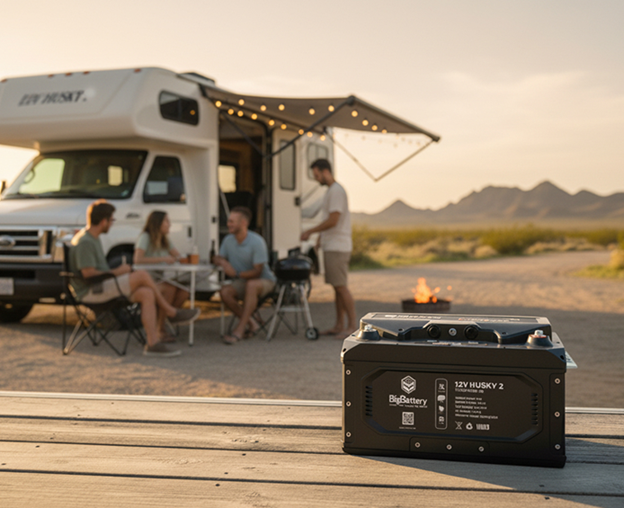
Explore Options Here or Get in Touch with Us
Not sure which LiFePO4 battery represents the best upgrade for your intended application? LiFePO4 batteries are widely used in automotive and marine applications, as well as in RVs and elsewhere, but there are many different options to choose from.
If you need help getting started with finding an appropriate replacement, get in touch with us and we will be more than happy to help.
Frequently Asked Questions
How long do LiFePO4 batteries last?
A quality LiFePO4 battery can commonly deliver 4,000 or more charge cycles, often roughly 10 years or longer under the right conditions. Depth of discharge, temperature, charge settings, storage habits, and the BMS all affect the result.
How many years is 4,000 cycles?
One full cycle per day is about 11 years. Three cycles per week is more than 25 years on paper, though calendar aging becomes the limit first.
What happens at the end of a LiFePO4 battery's life?
It does not suddenly stop. It loses capacity gradually. A battery rated for 4,000 cycles may be specified to keep around 80% of its original capacity at that point.
Does temperature affect LiFePO4 battery life?
Yes. High heat speeds aging, and charging below freezing can damage cells unless the battery has low-temperature protection or self-heating.
How long does a lithium battery last in an RV?
Many years, when charging sources are configured correctly and the battery is protected from freezing charge conditions. Annual cycles are often fewer than in a daily solar system, but conditions vary more.
How should I store a lithium battery?
Store it at a partial state of charge in a clean, dry, moderate-temperature location. Disconnect parasitic loads and check it periodically per the manufacturer's guidance.