



Anyone who has run a lead-acid bank knows the frustration. Much of the rated capacity is off limits if you want the batteries to last, so a bank that looks large on paper delivers far less in practice.
A LiFePO4 battery changes that. It delivers more usable energy, holds steadier voltage under load, and needs far less attention. This guide explains where the difference comes from and how to choose the right voltage and size.
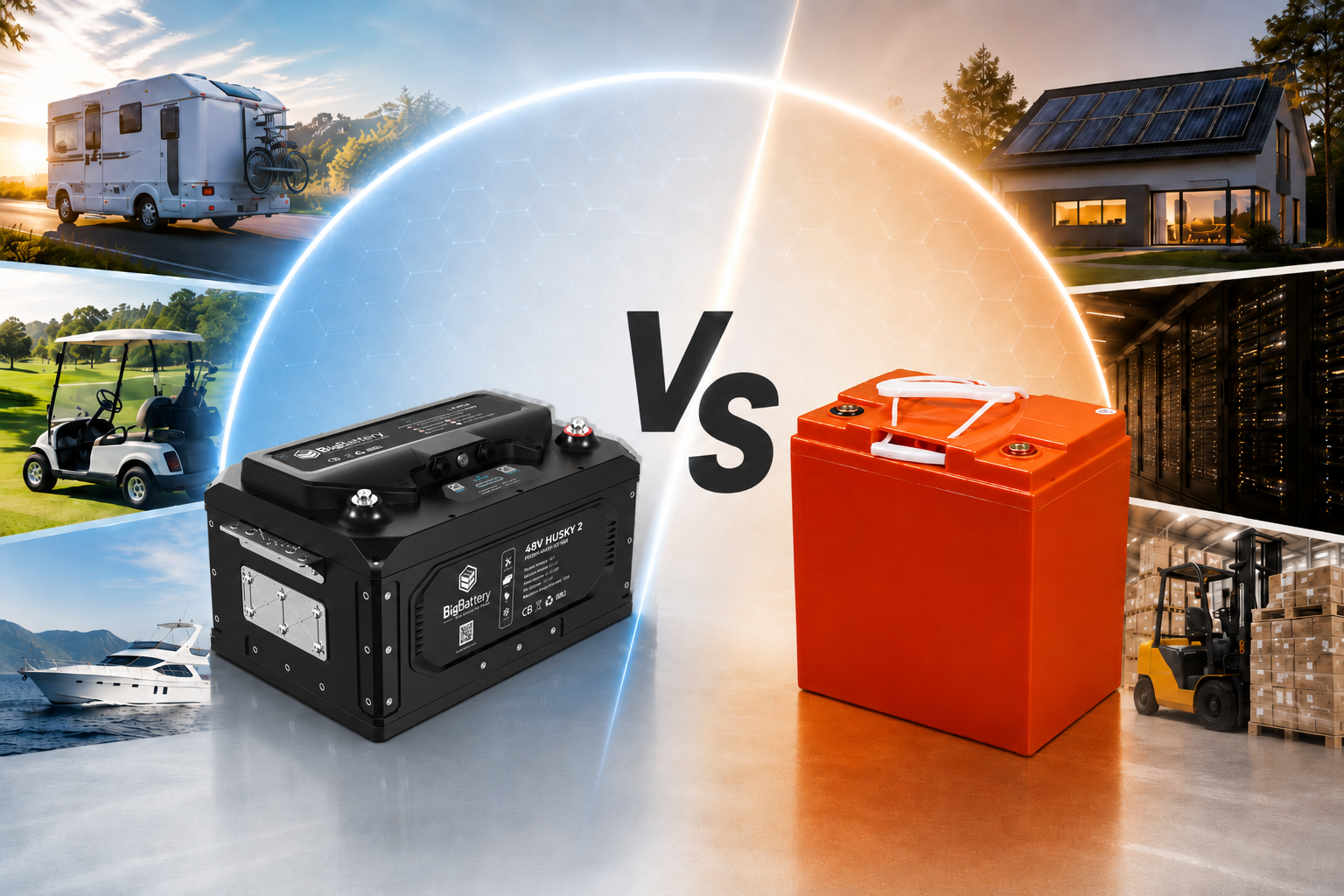
A LiFePO4 battery gives you far more usable energy than lead acid. Plan around about 50% of rated capacity for lead acid and about 80% for LiFePO4. A 100Ah lithium battery then delivers 80Ah of usable energy against 50Ah, roughly 60% more, and it holds voltage better under load. It also charges faster, lasts 4,000 or more cycles, and needs no routine maintenance. Check out our LiFePO4 Battery Options.
What Makes a LiFePO4 Battery Different?
Lithium iron phosphate is a deep-cycle chemistry. Unlike a starter battery, which delivers a short burst of current to crank an engine, a deep-cycle battery is designed to supply energy steadily and repeatedly. A deep cycle lithium battery does this work with less weight and far more usable capacity than a lead-acid equivalent.
LiFePO4 is lighter and charges faster than lead acid. A quality unit can deliver 4,000 or more charge cycles, depending on depth of discharge, temperature, charging practices, and system design.
Lithium iron phosphate batteries and lead-acid batteries differ in ways you notice every day:
LiFePO4 Batteries vs Lead Acid
| Feature | LiFePO4 | Lead acid |
|---|---|---|
| Usable capacity | About 80% planned | About 50% planned |
| Cycle life | 4,000 or more cycles | May need several replacements over the same period |
| Weight | Lighter | Heavy |
| Charging | Faster | Slower |
| Maintenance | No routine maintenance | Flooded types need regular upkeep |
| Voltage under load | Stays more stable | Sags as it discharges |
| Upfront cost | Typically higher | Typically lower |
The value is in usable energy and service life, not the sticker price. A cheap lead-acid bank may need several replacements over the life of one lithium battery.
Usable Capacity Is the Number That Matters
Lead-acid batteries are generally treated as about 50% usable if you want a long service life. A 100Ah lead-acid battery then gives you about 50Ah. LiFePO4 can be planned at about 80%, so a 100Ah lithium battery gives about 80Ah.
That is why a much smaller lithium battery can replace a larger lead-acid bank for the same practical runtime. BigBattery’s 12V Husky 2 (400Ah, 5.12 kWh) lists itself as replacing roughly four 12V 100Ah lead-acid batteries. It needs a lithium-profile charger, since AGM charge settings will undercharge it.
Voltage also stays steadier as a LiFePO4 battery discharges, so your equipment keeps performing near full strength instead of fading as the battery drains.
Why LiFePO4 Batteries Fit Demanding Applications
Weight, runtime, and uptime decide which battery works in demanding applications. Swapping a lead acid RV battery for a LiFePO4 battery for RV use removes weight and adds usable runtime. See BigBattery’s marine and golf cart lithium batteries too.
Floor machines, scissor lifts, utility vehicles and similar equipment benefit from steady power through the whole shift and fast recharging between uses.
LiFePO4 batteries for solar energy storage are also a practical choice for residential solar and backup power.

The Battery Management System Is Not Optional
A battery management system (BMS) protects the cells from overcharge, over-discharge, overcurrent, and temperature extremes. It is what makes lithium safe and long-lived. Choose a battery with a well-built BMS and open communications, and avoid proprietary lockouts that limit how you can use or expand your system.
Choose Voltage Before Choosing Capacity
Voltage should follow the application. 12V suits smaller RV, marine, and portable systems. 24V or 36V suits trolling motors, mobility, and utility equipment. Golf carts run 36V, 48V, or 72V systems. For home solar, 48V is the common choice because it moves the same power at lower current, allowing for more efficient system design.
BigBattery Examples by System Voltage
| Voltage | Example | Capacity | Energy | Common uses |
|---|---|---|---|---|
| 12V | Husky 2 | 400Ah | 5.12 kWh | Smaller RV, marine, trolling motor, portable power |
| 24V | Husky 2 | 200Ah | 5.12 kWh | Specific trolling motors, mobility, industrial equipment |
| 36V | 36V Eagle 2 | 40Ah | 1.54 kWh | Golf carts, utility vehicles, mobility equipment |
| 48V | Husky 2 | 100Ah | 5.12 kWh | Home solar, backup, off-grid, golf carts |
| 72V | RAPTOR 2 | 100Ah | 7.68 kWh | Golf carts and utility vehicles |
A 48V inverter needs a 48V battery system, so settle the voltage before you shop for capacity.
Size for Energy, Not Just Amp Hours
Amp hours alone do not tell you how much energy a battery holds. Use this formula:
Watt hours = nominal battery voltage × amp hours
LiFePO4 batteries run at 12.8V nominal for 12V and 51.2V nominal for 48V. A 12V 100Ah battery stores about 1,280 watt hours, or 1.28kWh. A 48V 100Ah battery stores about 5,120 watt hours, or 5.12kWh.
Voltage also changes current. A 1,000W appliance draws about 83A from a 12V system but only about 21A from a 48V system, so higher voltage allows thinner cable and less loss.
Trade-Offs of LiFePO4 Versus Lead Acid
LiFePO4 has real trade-offs. The upfront cost is typically higher. Older chargers may lack a lithium profile and need replacing. Cold-weather charging needs attention, because charging below freezing can damage cells unless the battery is built for it. Check discharge ratings, cable gauge, and fuses against your loads before you buy.
Installation Habits That Protect Your Investment
- Use short, properly sized cable.
- Add overcurrent protection sized to the cable and battery.
- Follow the manufacturer’s torque specifications on terminals.
- Use a lithium-compatible charger with no equalization mode.
- Wire parallel banks in a balanced layout.
- Monitor state of charge instead of guessing from voltage.
Do those things, and the sizing calculator will point you to a right-sized system. That is how a LiFePO4 battery becomes dependable power you can actually use when it matters.Anyone who has run a lead-acid bank knows the frustration. Much of the rated capacity is off limits if you want the batteries to last, so a bank that looks large on paper delivers far less in practice.
A LiFePO4 battery changes that. It delivers more usable energy, holds steadier voltage under load, and needs far less attention. This guide explains where the difference comes from and how to choose the right voltage and size.
A LiFePO4 battery gives you far more usable energy than lead acid. Plan around about 50% of rated capacity for lead acid and about 80% for LiFePO4. A 100Ah lithium battery then delivers 80Ah of usable energy against 50Ah, roughly 60% more, and it holds voltage better under load. It also charges faster, lasts 4,000 or more cycles, and needs no routine maintenance. Check out our LiFePO4 Battery Options.
What Makes a LiFePO4 Battery Different?
Lithium iron phosphate is a deep-cycle chemistry. Unlike a starter battery, which delivers a short burst of current to crank an engine, a deep-cycle battery is designed to supply energy steadily and repeatedly. A deep cycle lithium battery does this work with less weight and far more usable capacity than a lead-acid equivalent.
LiFePO4 is lighter and charges faster than lead acid. A quality unit can deliver 4,000 or more charge cycles, depending on depth of discharge, temperature, charging practices, and system design.
Lithium iron phosphate batteries and lead-acid batteries differ in ways you notice every day:
LiFePO4 Batteries vs Lead Acid
| Feature | LiFePO4 | Lead acid |
|---|---|---|
| Usable capacity | About 80% planned | About 50% planned |
| Cycle life | 4,000 or more cycles | May need several replacements over the same period |
| Weight | Lighter | Heavy |
| Charging | Faster | Slower |
| Maintenance | No routine maintenance | Flooded types need regular upkeep |
| Voltage under load | Stays more stable | Sags as it discharges |
| Upfront cost | Typically higher | Typically lower |
The value is in usable energy and service life, not the sticker price. A cheap lead-acid bank may need several replacements over the life of one lithium battery.
Usable Capacity Is the Number That Matters
Lead-acid batteries are generally treated as about 50% usable if you want a long service life. A 100Ah lead-acid battery then gives you about 50Ah. LiFePO4 can be planned at about 80%, so a 100Ah lithium battery gives about 80Ah.
That is why a much smaller lithium battery can replace a larger lead-acid bank for the same practical runtime. BigBattery’s 12V Husky 2 (400Ah, 5.12 kWh) lists itself as replacing roughly four 12V 100Ah lead-acid batteries. It needs a lithium-profile charger, since AGM charge settings will undercharge it.
Voltage also stays steadier as a LiFePO4 battery discharges, so your equipment keeps performing near full strength instead of fading as the battery drains.
Why LiFePO4 Batteries Fit Demanding Applications
Weight, runtime, and uptime decide which battery works in demanding applications. Swapping a lead acid RV battery for a LiFePO4 battery for RV use removes weight and adds usable runtime. See BigBattery’s marine and golf cart lithium batteries too.
Floor machines, scissor lifts, utility vehicles and similar equipment benefit from steady power through the whole shift and fast recharging between uses.
LiFePO4 batteries for solar energy storage are also a practical choice for residential solar and backup power.
The Battery Management System Is Not Optional
A battery management system (BMS) protects the cells from overcharge, over-discharge, overcurrent, and temperature extremes. It is what makes lithium safe and long-lived. Choose a battery with a well-built BMS and open communications, and avoid proprietary lockouts that limit how you can use or expand your system.
Choose Voltage Before Choosing Capacity
Voltage should follow the application. 12V suits smaller RV, marine, and portable systems. 24V or 36V suits trolling motors, mobility, and utility equipment. Golf carts run 36V, 48V, or 72V systems. For home solar, 48V is the common choice because it moves the same power at lower current, allowing for more efficient system design.
BigBattery Examples by System Voltage
| Voltage | Example | Capacity | Energy | Common uses |
|---|---|---|---|---|
| 12V | Husky 2 | 400Ah | 5.12 kWh | Smaller RV, marine, trolling motor, portable power |
| 24V | Husky 2 | 200Ah | 5.12 kWh | Specific trolling motors, mobility, industrial equipment |
| 36V | 36V Eagle 2 | 40Ah | 1.54 kWh | Golf carts, utility vehicles, mobility equipment |
| 48V | Husky 2 | 100Ah | 5.12 kWh | Home solar, backup, off-grid, golf carts |
| 72V | RAPTOR 2 | 100Ah | 7.68 kWh | Golf carts and utility vehicles |
A 48V inverter needs a 48V battery system, so settle the voltage before you shop for capacity.
Size for Energy, Not Just Amp Hours
Amp hours alone do not tell you how much energy a battery holds. Use this formula:
Watt hours = nominal battery voltage × amp hours
LiFePO4 batteries run at 12.8V nominal for 12V and 51.2V nominal for 48V. A 12V 100Ah battery stores about 1,280 watt hours, or 1.28kWh. A 48V 100Ah battery stores about 5,120 watt hours, or 5.12kWh.
Voltage also changes current. A 1,000W appliance draws about 83A from a 12V system but only about 21A from a 48V system, so higher voltage allows thinner cable and less loss.
Trade-Offs of LiFePO4 Versus Lead Acid
LiFePO4 has real trade-offs. The upfront cost is typically higher. Older chargers may lack a lithium profile and need replacing. Cold-weather charging needs attention, because charging below freezing can damage cells unless the battery is built for it. Check discharge ratings, cable gauge, and fuses against your loads before you buy.
Installation Habits That Protect Your Investment
- Use short, properly sized cable.
- Add overcurrent protection sized to the cable and battery.
- Follow the manufacturer’s torque specifications on terminals.
- Use a lithium-compatible charger with no equalization mode.
- Wire parallel banks in a balanced layout.
- Monitor state of charge instead of guessing from voltage.
Do those things, and the sizing calculator will point you to a right-sized system. That is how a LiFePO4 battery becomes dependable power you can actually use when it matters.
Get Help Choosing a LiFePO4 Battery
BigBattery’s Texas-based experts can help you match voltage, kWh capacity, and inverter compatibility before you install. Shop LiFePO4 batteries by voltage, run your loads through the Solar Battery Sizing Calculator, or call (818) 280-3091.
Frequently Asked Questions
Is a LiFePO4 battery better than lead acid?
For deep-cycle use, usually yes. A LiFePO4 battery gives more usable capacity, steadier voltage under load, faster charging, less weight, and no routine maintenance. Lead acid costs less upfront, which can suit light or occasional use.
How much more usable capacity does LiFePO4 have?
Plan around about 50% of rated capacity for lead acid and about 80% for LiFePO4. A 100Ah lithium battery then delivers about 80Ah of usable energy against 50Ah, roughly 60% more.
How long does a LiFePO4 battery last?
A quality LiFePO4 battery can deliver 4,000 or more charge cycles under appropriate conditions. Depth of discharge, temperature, charging practices, and system design all affect real-world life.
Can I replace a lead-acid battery with LiFePO4?
Often yes, if the voltage matches and your charger, cables, fuses, and discharge limits suit lithium. Older chargers without a lithium profile, and AGM charge settings, will undercharge or mismanage a LiFePO4 battery.
Can I charge a LiFePO4 battery in freezing weather?
Charging below freezing can damage lithium cells unless the battery is built for it. Check the battery's listed charge temperature range. Self-heating models are designed to warm the cells before charging in the cold.
Is LiFePO4 worth the higher upfront cost?
For daily cycling, usually. You get more usable energy per rated amp hour, far more cycles, and less maintenance, and a lead-acid bank may need several replacements over the same period. For rare, light use, lead acid can still make sense.